The Art of Pricing: Behavioral Economics Behind Airline Fares Revealed
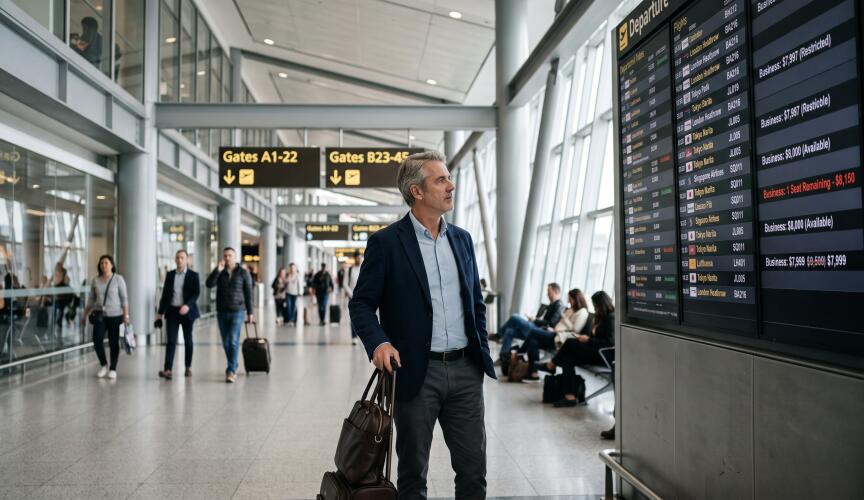
Airline pricing follows many principles of psychology to steer customers’ booking decisions. Take price endings for instance. Most consumers care deeply about $2,997 vs. $3,000, even though it's only a difference of $3. Why? A concept known as left-digit bias (which is anchoring). Humans anchor to the leftmost digit and “see” “2,9xx” as part of the 2,000s, not the 3,000s. Research proved consumers perceive $4.00 dropping to $2.99 was a better deal than $4.01 decreasing to $3.00, despite both prices changing by precisely $1. Therefore airlines price many fares ending in “.97,” “.99,” or “.95” so tickets are perceived as being in the lower thousand. Psychology 101: left-digit bias tricks your brain into seeing $2,997 as much cheaper than $3,000.
Airlines don’t just anchor with price points; they set reference prices too. By displaying the “original” fare then offering a discounted sale price, they establish an anchor in your head. Once established, that anchor affects how you perceive the deal. Many people don’t do math. Instead our brains rely on rules-of-thumb and comparisons to internal reference prices. Point proven: behavioral economists have found that “Was $3,500, now $2,800” makes customers believe $2,800 is insanely cheap, even if $2,800 was the true market value alone.
The FOMO Factor
The fear of missing out doesn’t stop there. Airlines trigger FOMO with seat availability messages like “Only X seats left at this price.” Psychologists know when people believe something is in short supply, their brain automatically assigns value. In fact, according to Wharton marketing professor Cait Lamberton, one branch of behavioral economics predicts that if you encounter a deal that you know won’t last, you’re paying more because your brain is reacting to artificial scarcity. Seats are “about to run out” tricks travelers into making faster decisions “or risk being stranded,” according to one behavioral economist. When you see “low inventory” warnings, your brain worries you might miss out. Even if you’re a frequent business traveler who hates waiting for others, you’ll feel pressured to book that flight before it's gone.
Flash sales and last-minute deals are another classic trick. If a price could change any second, you better buy now or you’ll “miss out.” Urgency cues can be as subtle as sale timers (“Deal ends tonight!”) or dropping prices by X amount every hour. According to behavioral experts, when a deal is framed as expiring soon, part of what’s driving your decision is you don’t want to feel like you missed out on something that could be beneficial. Note how airlines, and many booking sites, weaponize this knowledge. Type “sale” into Google and you'll see dozens of sites flashing red “LIMITED TIME” clocks in the upper corner. This creates artificial urgency, leading you to believe if you don’t book now, you’ll lose money.
Note the Ticket Selling Approach
Next, understand how airlines actually sell tickets. Offstage, airlines use algorithms known as dynamic pricing to raise and lower fares throughout the day. What’s more, flights typically have multiple sets of seats at different prices, called fare “buckets” or booking classes. As a current airline insider explains,”when you see a flight go from $500 to $550 just as you click to book, that doesn’t mean someone at the airline got up and decided to raise prices. It means there are no more $500 seats, the next cheapest bucket is $550.” What you may not realize is every flight has “multiple buckets” with artificially low prices that rise as they sell out.
Some airlines have access to advanced systems that monitor demand, track competitors’ prices down to the penny, and dynamically raise or lower fares based on predictive buyer behavior. In fact approximately 80% of airlines use some kind of dynamic pricing technology. So if you search a route today, then wait an hour to search it again, there's a good chance the price will change because the algorithm just adjusted. If everyone searches or books, the algorithm thinks ‘demand is increasing’ and will likely raise the price. Why do prices change so frequently? Because too many people are looking or booking that flight.
Take Notice of When Prices Jump
You should know, when prices increase after your initial search, it’s usually because the sale ended (i.e. lowest-priced bucket sold out), NOT because the airline decided, en masse, to charge you more for the same seat. In fact, clearing cookies or browsing from another phone may even trick booking sites into withholding these “customized” fares. But ultimately, if you wait too long there’s always a chance prices could go up. Wait too long and you’ll probably pay more. Another thing to know about these “price buckets”: if you see pop-ups notifying you “Only 1 seat left at this price” on certain fares, they’re not always a sign of low seat availability. Sometimes sales really are about to expire, but other times, it’s merely an indicator that you’re approaching the next price bucket.
Want an insane competitive advantage when booking flights? Recognize how airlines frame their pricing. According to pricing psychology experts, airlines use decoy pricing to trick you into upgrading. How does it work? Say you’re presented with three fares. One is basic economy, one is premium economy. But the third is over-priced business class with fewer perks than even the premium economy seat. Behavioral economist Dan Ariely explains this tactic forces travelers to choose between the premier belt seat or “that pricey business class with useless perks.” When you carelessly accept the airline’s allowed “middle-ground” pricing, you’ve fallen for a classic decoy.
While airlines love posting messages that say “X other customers are viewing this fare,” research says those who fall for social proof fare pricing tend to overpay. Plus did you know airlines use “drip pricing?” They reveal extra fees slowly throughout the booking process so you default to buying. Researchers ran an experiment on this topic through Marketing Science. When prices were hidden, then revealed bit by bit, “consumers made suboptimal decisions because they didn’t want to lose the time they had already invested.” Translation: by the time you click “purchase,” you agree to fees you might’ve otherwise rejected. But since you’ve already “paid” in time, you just cough up the cash.
Business class travelers should take note of price framing. Luckily, ‘loopiness’ tactics rarely apply to flat fare comparisons. Most business flyers won’t feel ultra discounted paying $9,500 for biz if they see a coach fare for $7,500 right next to it. Which is why airfare framed as $7,997 is ALWAYS cheaper than $8,000.
How TravelBusinessClass Can Help
So how do you avoid getting scooped by airlines’ psychology tricks? Well as a business traveler, you can start by doing comparison shopping on all angles (don’t forget extra fees!) and booking during the optimal “sweet spot” (generally 4-6 weeks prior). Try clearing cookies or using incognito mode to prevent sites from “learning” about you (many dynamic pricing tricks are based on your search history). Whatever you do, don’t BOOK IN THE LAST MINUTE. You will definitely regret it.
Hiring help can also give you an edge. Using a service that specializes in business class travel, like TravelBusinessClass, can really tilt the odds in your favor. As soon as you tell one of our booking agents your travel preferences (favorite airlines, destinations, dates, seat preferences), they start searching for the perfect itinerary to match YOUR needs. Then they’ll email you options that often fit your schedule and are up to 60% less than what you’ll find shopping on your own.
Why can we find such great business fares? TravelBusinessClass deals directly with the world’s most trusted airlines meaning the fares you see on Google are sometimes inflated or don’t include all the seats/business classes available. TravelBusinessClass agents have insider knowledge to see past flashy sales tactics and source real deals directly from the source. Having an advocate on your side means you no longer have to waste hours searching for seats. Let TravelBusinessClass do the work so you can sit back and relax.
Key Takeaways
Remember airlines want to sell you on yesterday’s fares and charge you for it today. Airlines secretly price flights using behavioral economics to trick your brain into booking ASAP. Whether they’re raising prices through “bucketing”, hiding markup via drip pricing, or creating false urgency with low seat warnings, airlines weaponize psychology to drive profits. But YOU can fight back!
Use the power of behavioral economics against airlines. Book when you have time to compare shops, not right before your trip. Research flights in private browsing mode to avoid manipulated search histories. Work with a travel agent that understands business class options exist beyond what Google shows. TravelBusinessClass gives you personal 24/7 agent support while also sourcing hard-to-find deals directly from airlines. Armed with these tips and TravelBusinessClass on your side, you’re suddenly holding all the aces!